
Disorder slot review with the official 96.11% RTP, high volatility, 23,500x maximum win, mechanics, bonus modes, bets and free demo.
Slot Characteristics
| Provider | Nolimit City |
| Release Date | 04.11.2025 |
| Return to player (RTP) | 96.11% |
| Volatility | High |
| Max Win | x23500 |
| Min Bet | 0.2 |
| Max Bet | 100 |
| Label | 4-3-4-3-4-3 |
| Betways | alternating 4-3-4-3-4-3 reel heights with a changing ways counter |
| Features | Enhancer Cells, Fire Frames, Infectious xWays, xBomb, Obsessive Compulsive, Antisocial Personality and Severe Dissociative Identity Spins |
Play Disorder slot Free Demo
Get a free play bonus
100% match bonus based on first deposit of £/$/€20+. Additional bonuses.
100% match bonus based on first deposit of £/$/€20+. Additional bonuses.
100% match bonus based on first deposit of £/$/€20+. Additional bonuses.
Pros and cons
- Distinctive alternating 4-3-4-3-4-3 reel heights with a changing ways counter design
- Official 96.11% RTP is competitive for the catalog
- Mechanic states can be checked in the free demo
- Desktop and mobile HTML5 support
- A clearly defined 23,500x payout cap
- High volatility can produce sharp balance swings
- Optional boosters can multiply the cost of one action
- For Disorder, the headline maximum is rare and must not be treated as a target
Disorder Slot Review
Disorder is a Nolimit City slot released on 04 November 2025. It uses 4-3-4-3-4-3 and an official RTP of 96.11%, with high volatility and a 23,500x cap. For Disorder, those figures describe a long-run model, not what one demo or paid session should return.
The practical reason to review Disorder is to decide whether its central system is understandable before any real-money play. Here that system is alternating 4-3-4-3-4-3 reel heights with a changing ways counter, supported by Enhancer Cells, Fire Frames, Infectious xWays, xBomb, Obsessive Compulsive, Antisocial Personality and Severe Dissociative Identity Spins. For Disorder, the review therefore separates what the board shows, what the rules actually evaluate and which state—if any—survives into the next collapse, respin or free spin.
Theme, Graphics and Sound
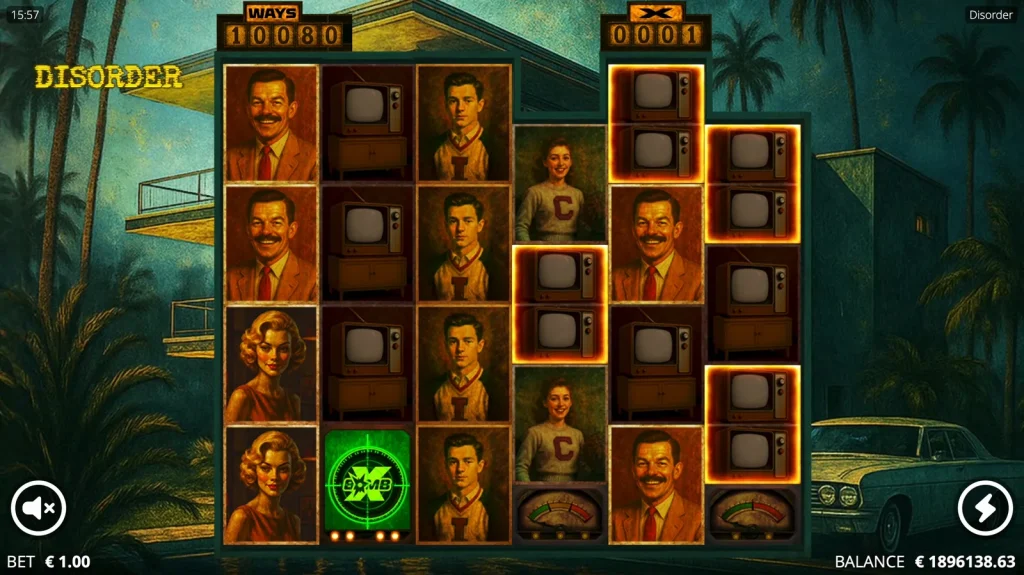
For Disorder, Nolimit City builds the presentation around the mechanism rather than placing a generic theme behind it. The suburban house shifts between a bright family facade and a burnt interior, mirroring the game's two board states. Television-shaped cells, portraits and scorched frames make the horror narrative functional: a visual change usually identifies which modifier pool is active. For Disorder, important states remain visible near the reels, but the screen can still become busy when several special effects resolve in sequence. For Disorder, turning off quick play for the first demo run makes the cause of each change much easier to follow.
For Disorder, the soundtrack and impact effects escalate when Enhancer Cells becomes active, giving the round a clear dramatic arc. For Disorder, audio is useful as feedback, not evidence of improved odds: a rising cue, long anticipation or emphatic near miss does not change the next random result. For Disorder, on mobile, lower volume also makes repeated feature sounds less tiring during a rules check.
Grid, Bets and Win Evaluation
Winning symbols are evaluated through a variable ways grid. Enhancer Cells can reveal regular modifiers; Fire Frames mark more aggressive positions, and xBomb or Infectious xWays can alter the available symbols before the next evaluation. The official bet range is 0.2 to 100 units. For Disorder, a player should confirm the current total stake after enabling any booster, because an option expressed as a multiple can make the amount removed from the balance much larger than the base stake shown in the first control.
With a maximum stake of 100 and optional paid features, Disorder can change session exposure quickly. For Disorder, a fixed monetary budget and a fixed stop point are more useful than a target based on recovering losses. For Disorder, reduce the base stake before testing a multiplier option so that the final debit per round remains within the original limit.

Core Mechanics Explained
Infectious xWays selects a regular symbol, expands its mystery tile and spreads that expansion to matching visible copies. The ways counter should be read after infection completes. Counting the board earlier understates the final connections and can make the settlement look inconsistent.
xBomb removes eligible surrounding symbols and creates another drop. Fire Frames identify enhanced positions that may keep or improve feature state depending on the active personality mode. A frame is therefore a location marker, not a Wild and not an independent payout.
How Special Symbols Change the Board
The three bonus names correspond to different starting mixtures of normal and Super Bonus symbols. Obsessive Compulsive is the lower state, Antisocial Personality adds stronger setup, and Severe Dissociative Identity is the premium configuration. The names do not change the underlying need for connected ways after modifiers resolve.
These rules make Disorder state-dependent: the same symbol can be valuable or ineffective according to position, timing and the objects already in view. For Disorder, read the completed evaluation rather than treating animation length as a measure of win quality.
Free Spins and Bonus Progression
Three Bonus symbols with no more than one Super Bonus enter Obsessive Compulsive Spins; a stronger mix upgrades the starting state, and at least two Super Bonus symbols opens Severe Dissociative Identity Spins. Fire and Enhancer progress determine which modifiers are available, so record the starting symbol mix rather than relying on the feature title alone.
Bonus access does not suspend the normal risk model. In Disorder, count the awarded spins and visible upgrades at the start, then separate retriggers from transformations of the remaining spins. For Disorder, that produces a more accurate comparison than judging a feature by its loudest single animation.
RTP, Volatility and Hit Frequency
The published math allocates 59.74 percentage points of RTP to the main game and 36.37 to bonus play. Hit frequency is 25.95%. Nolimit City lists a 100x-or-better result at roughly one in 604 bets, free spins at one in 270, and the maximum at approximately one in 2,700,000. For Disorder, these measures answer different questions, so none should be used as a substitute for the others.
The 96.11% configuration allocates 59.74% to base and 36.37% to bonus play. Hit frequency is 25.946%; 100x is roughly 1:604, free spins 1:270 and the 23,500x cap 1:2.7 million. Certified options are 96.11%, 94.12% DX1 and 92.12% DX2. For Disorder, the value shown by a licensed operator's own help screen governs that deployment; no short sample can validate long-run return.
Boosters, Feature Buys and True Cost
Bonus Booster is 2x, Fire Booster 4x and Enhancer Booster 15x. Direct entries cost 80x, 300x and 800x for the three personality modes; the 370x Lucky Draw uses a 25/50/25 distribution. Those percentages describe selection weights, not chances of profit.
For Disorder, a price such as 10x means ten times the selected base bet is risked on that action. For Disorder, it does not mean a 10x return, added RTP or improved value. Test the option in Disorder's demo and recheck the total stake whenever the base bet changes.
Maximum Win and High Risk
The official cap is 23500x the base bet, with the current game sheet quoting 1 in ~2.7M spins for the standard RTP model. This is a technical boundary, not a session target. Feature graphics cannot turn the published probability into a countdown.
For Disorder, define both a money limit and an observation limit before the demo begins. For Disorder, optional actions belong to the same entertainment budget; persistent-looking cells, multipliers or meters are not assets and never justify extending a paid session.
Desktop and Mobile Experience
For Disorder, the official specification supports HTML5 play on desktop and mobile at a 16:9 aspect ratio. The 4-3-4-3-4-3 layout remains usable on a phone, although small counters and multiplier labels deserve a landscape view. For Disorder, the same mathematical game should load on both devices; screen size changes interface comfort, not RTP or volatility.
At phone width, verify the alternating reel tops and ways counter remain visible; desktop should show Fire Frames without the review box covering the lower grid. For Disorder, a working free frame does not prove real-money availability, licensing or legal access in the visitor's location.
Practical Free-Demo Checklist
A focused demo test for Disorder should take notes rather than chase a result. Split observations into 'house' and 'burnt' states. Draw each alternating reel height, circle Fire Frames and write the final ways number only after Infectious xWays or xBomb completes. For bonuses, list normal versus Super Bonus symbols before the first free spin. For Disorder, repeat the observation at the lowest speed before trying turbo or Action modes.
For Disorder, also compare the cash balance before and after one ordinary spin, one enabled booster and any offered extra action. For Disorder, open the in-game rules to verify the displayed RTP, maximum and feature price. For Disorder, if a mechanic remains unclear after that sequence, the correct conclusion is that the game needs more free-play study—not that a paid round will explain it better.
Capture ten ordinary outcomes in each visual state and annotate only observable transitions: cell reveal, infection target, bomb radius, frame persistence and final ways. The target is rule consistency, not hit-rate estimation. A second pass should compare the same labels on desktop and 390-pixel mobile portrait.
Final fact check: Certified options are 96.11%, 94.12% DX1 and 92.12% DX2. The standard sheet also lists 25.95% hit frequency, about 1:604 for 100x and 1:270 for free spins. Record those as separate long-run measures.
Who Will Enjoy Disorder?
Disorder is for players who appreciate board-state storytelling and can follow a variable grid. It is not ideal for readers sensitive to domestic horror or for anyone who treats a 25/50/25 Lucky Draw as a strategic choice. For Disorder, players who do continue should treat every spin as independent and use the operator's deposit, loss and time limits where available.
The strongest reason to choose Disorder over another Nolimit title is its specific interaction between Enhancer Cells, Fire Frames, Infectious xWays, xBomb, Obsessive Compulsive, Antisocial Personality and Severe Dissociative Identity Spins. For Disorder, theme preference alone is a weaker differentiator because the risk distribution controls the financial experience. For Disorder, anyone uncertain about the rules can use the official demo without registering or depositing.
A practical decision rule for Disorder is to choose it for alternating 4-3-4-3-4-3 reel heights with a changing ways counter and the interaction between Enhancer Cells, Fire Frames, Infectious xWays, xBomb, Obsessive Compulsive, Antisocial Personality and Severe Dissociative Identity Spins, not for the headline cap. For Disorder, if the free-demo worksheet cannot explain a completed round without guessing, a simpler game is the better comparison. For Disorder, mechanical interest is a valid entertainment preference; confusion, recent losses and a nearly completed meter are not reasons to continue.
Best Casinos with Disorder Slot
1GO combines a crypto converter with marketing around withdrawals without verification. The converter is useful; the verification phrase needs a hard boundary because AML, source-of-funds and risk checks can still be required under the terms.
Arkada is the most layered CatAffs product, combining quests, Coins, lootboxes, free spins and cashback. The variety creates genuine choice but also makes cash valuation harder; it is best for readers who document each balance separately and ignore progress pressure.
Beef is aimed at regular slot play through wager-based rakeback and activity tiers. That can be more measurable than a one-off gift, but only net-loss calculation, eligible wagering and payout timing determine whether the displayed rate has practical value.
Cat Casino has more historical CatAffs documentation than its siblings because the public affiliate agreement is Cat-centred. That history does not establish the present casino operator, and current cross-brand promotions sometimes give Cat a different reward, making brand-specific terms the central decision point.
Where to Play and Demo Options
The embedded version on this page uses Nolimit City's official Disorder demo. It is intended for learning the interface and feature order. For Disorder, if real-money links are considered later, check that the operator is licensed for the player's location, states the same RTP version and publishes its bonus wagering, withdrawal and verification terms.
For Disorder, availability changes by country and operator, and a listed casino relationship is not a promise that the game can be played everywhere. Never use a VPN to bypass local restrictions. For Disorder, adults who feel pressure to continue, increase stakes or recover a loss should stop and use the blocking and self-exclusion tools provided in their jurisdiction.
Disorder Review Verdict
Disorder turns psychological fragmentation into a coherent state machine rather than a collection of unrelated effects. Its best feature is the visible connection between burnt positions and stronger modifiers; its main cost is the concentration required to audit the final ways count. On balance, the editorial rating is 9/10.
Use the demo to verify the rules for alternating 4-3-4-3-4-3 reel heights with a changing ways counter, then decide on entertainment value before considering cost. The published 96.11% RTP and 23,500x maximum are useful reference points, but the decisive question is whether the player understands how a normal round can lose and is comfortable stopping within a predetermined budget.
Slot Screenshots
Frequently Asked Questions
What is the RTP of Disorder?
The official catalog lists 96.11% RTP. For Disorder, the live operator help file should be checked because available configurations can differ.
What is the maximum win in Disorder?
The round is capped at 23,500x the base bet. Nolimit City lists the maximum probability at approximately one in 2,700,000.
How volatile is Disorder?
Nolimit City classifies the slot as High. For Disorder, use a small fixed budget and expect short results to differ substantially from the long-run RTP.
How often does Disorder pay?
Official hit frequency is 25.95%. For Disorder, a hit can be smaller than the stake, so hit rate is not the same as profit frequency.
What win system does Disorder use?
It uses alternating 4-3-4-3-4-3 reel heights with a changing ways counter. For Disorder, the review’s demo method explains which board state must be recorded before a result is counted.
Which RTP versions of Disorder are certified?
Certified options are 96.11%, 94.12% DX1 and 92.12% DX2. For Disorder, check the deployed help file because operators can select a lower certified model.
Which Disorder feature should be tested first?
Split observations into ‘house’ and ‘burnt’ states. For Disorder, use free play and leave every paid shortcut disabled for the first pass.
Does the Disorder demo predict real results?
No. For Disorder, the official demo is useful for interface and rule verification, but a small observation set cannot predict RTP, hit frequency, bonus frequency or the next outcome.
Disorder Slot Review
Slot Verdict
Disorder turns psychological fragmentation into a coherent state machine rather than a collection of unrelated effects. Its best feature is the visible connection between burnt positions and stronger modifiers; its main cost is the concentration required to audit the final ways count.
Official data: 96.11% RTP, high volatility, 25.95% hit frequency and a 23,500x cap.